Best-in-class Simulation
Best-in-class simulation software for the forging industry
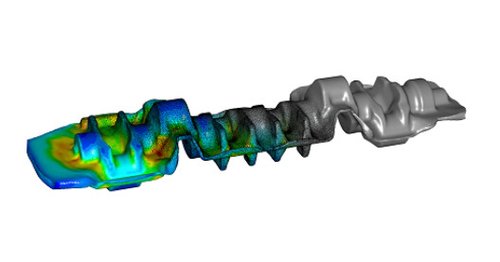
Apex Forging launchs the best-in-class software solution for the simulation of hot and cold forming processes. It fulfills the needs of companies producing forged parts for a variety of industrial sectors.
Processes
- Closed-die forging
- Open-die forging
- Long and flat products rolling
- Shape rolling
- Ring rolling
- Cross-wedge rolling
- Orbital forging
- Electrical upsetting
- Cold forming
- Bending
- Sheet metal forming
- Hydroforming
- Superplastic forming
- Glass forming
- Blanking and cutting
- Machining
- Flow forming
- Heat treatment
Anticipate the presence of defects
Apex Forging has unique features such as point tracking to easily detect any cold-shut areas in the part and to predict metal fibering which is essential to ensure that forgings possess good mechanical properties. Innovative marking techniques allow to materialize the segregations located in the center of the billet or to identify flow-through defects.
Apex Forging incorporates several damage criteria that can be enabled to detect critical areas on the part.
Forging tools and equipment
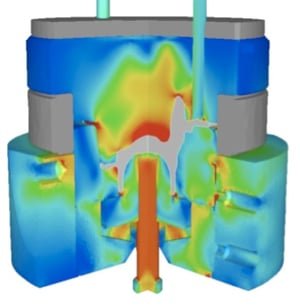
Tool life is a major challenge for which Apex Forging predicts stresses, abrasive wear, temperatures and also areas subject to elastic or plastic deformation.
Apex Forging predicts forging loads, energies consumed,torques and powers developed during each deformation operation. Then you can anticipate whether the effort required does not exceed the maximum capacity of your equipment, balance forging loads between the different stages and view die balancing and deflection problems.
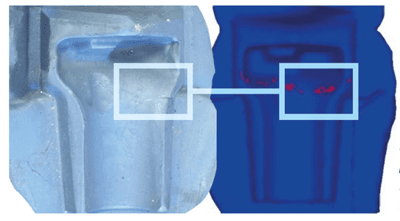
Fold/lap analysis: accurate folds/laps prediction of a mining steel component.
Fold/lap area is shown in red inside the frame.
Optimizing material savings
Apex Forging has been a provider to promote the concept of automatic optimization applied to material forming processes. Optimizing the starting billets to automatically improve yield or determining the ideal rolled preforms to ensure complete and defect-free die filling. Applied to forged components, automatic optimization allows the reduction of material costs by decreasing initial billet weight, do savings on energy cost by decreasing press load and extend die life by minimizing stress levels in the dies.
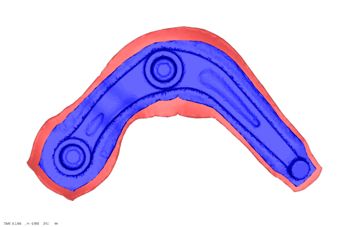
Optimization of the amount of flash.
Before optimisation (red) and after optimisation (blue)